

A countertop quotation can look complete while leaving out slab identification, seam placement, support, access charges, warranty exclusions and installation responsibility. By asking the questions below, you can compare materials and suppliers on evidence, approve the actual slab before cutting, and avoid paying for surprises or correcting preventable site errors.
Key takeaways
- Get the manufacturer, collection, slab number and lot number in writing.
- Confirm whether cutting, edging, supports, sink work and installation are included.
- Ask who pays when a slab arrives damaged or site measurements change.
- Inspect seams, edges, cut-outs and the finished surface before paying in full.
What exactly is the material, and which slab will be used?
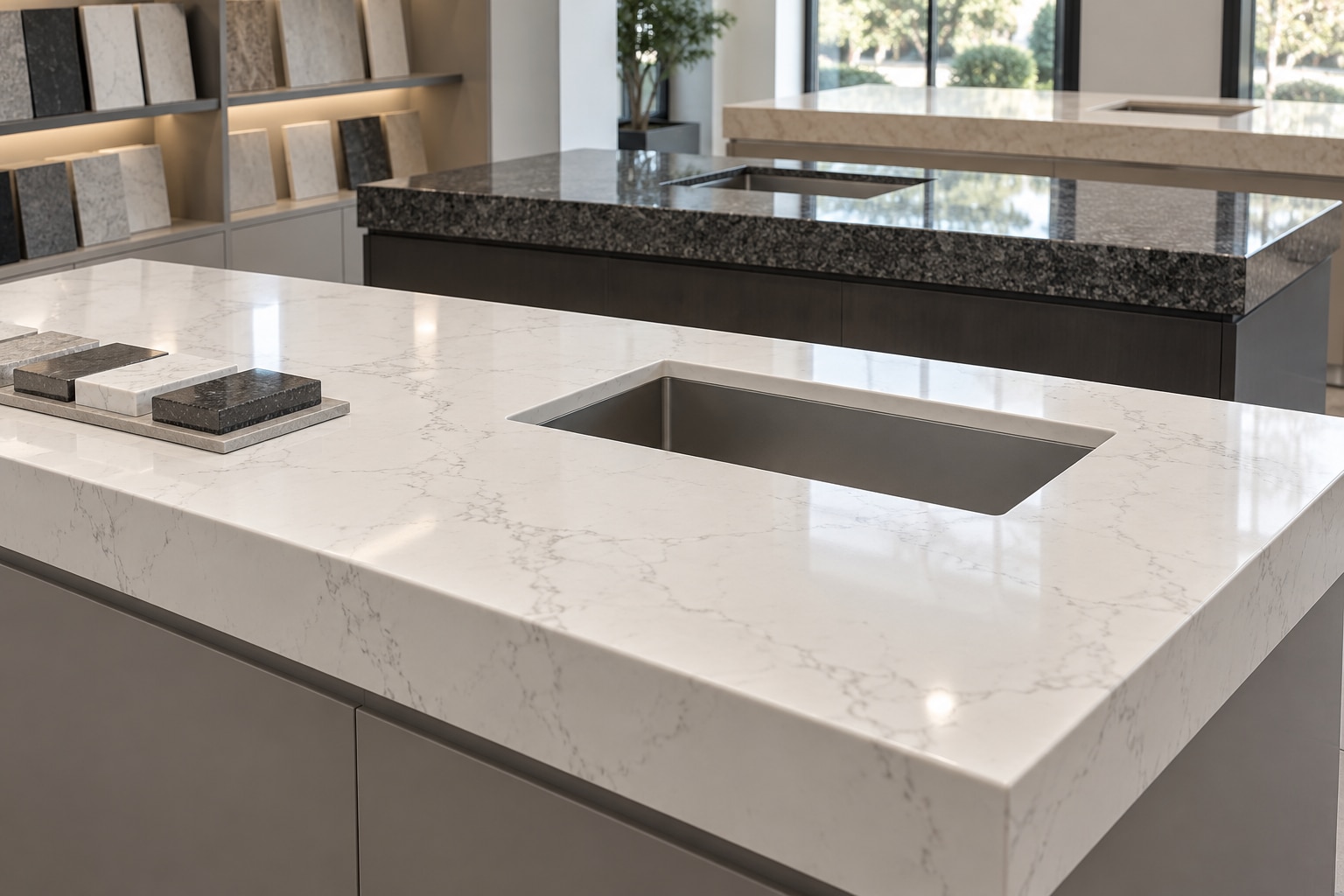
The written specification must identify whether you are buying resin-based engineered quartz, natural granite or a porcelain slab, not merely a colour name. Ask for the manufacturer and collection name, slab number and lot number, countertop thickness, dimensions, country of origin, and the exact slab reserved for your kitchen.
Confirm that the quotation covers that slab rather than a showroom sample.
Request full-slab photographs and inspect them before cutting for shade variation, veining, pinholes, resin marks, cracks, chips, warping and repaired areas. This is essential granite slab information: background colour, mineral concentration, pits and fissures vary across natural stone. Approve the granite layout before fabrication, including any bookmatching or vein alignment.
Ask for these documents and decisions in writing:
- The surface finish: polished, honed or textured, plus cleaning instructions for that exact product.
- Named specifications for heat resistance, scratch resistance and stain resistance, replacing sales claims such as “premium” or “durable”.
- The product warranty, including exclusions for heat damage and unsuitable cleaners.
| Quartz countertop material | Ask for the manufacturer’s heat limit and use trivets under hot cookware. | Heat damage is commonly excluded. |
|---|---|---|
| Natural granite | Ask whether granite sealing is needed, which sealer will be used and how absorption justified it. | Sealing depends on the stone. |
| Porcelain slab | Request the fabrication manual and confirm suitable cutting, drilling and edge equipment. | Hardness and heat resistance do not prevent cracks from poor handling. |
What does the quotation include, and what could add to the price?
Before paying a deposit, request an itemised countertop quotation. It should separate slab cost from measurement, templating and measurement, cutting, edge profile, sink cut-out, hob cut-out, backsplash cost, transportation and lifting, installation, sealing, plumbing disconnection, GST and disposal.
Ask whether you pay for the full slab or only the measured area. Confirm who pays for unusable offcuts and breakage, remakes and an additional slab. A low headline price can conceal site charges, so ask whether the quotation includes:
- Demolition, disposal, plumbing disconnection and reconnection
- Cabinet levelling, reinforcement and wall scribing
- Electrical work, backsplash work, delivery, crane or stair access
- Final sealing and preparation of cabinets for installation
Confirm the number of seams, colour-matched adhesive and seam finishing included. Ask for seam placement marked on the drawing; seams near sinks, hobs, corners and heavily patterned areas attract attention. Calacatta veining may require extra material and labour for bookmatching or vein alignment, while dramatic patterns make seams, stains, chips and repairs easier to see.
Ask whether the chosen edge profile reduces usable surface area, complicates corner cleaning or increases fabrication cost. Confirm whether a quoted 40 mm countertop is solid material or a thinner slab with a laminated edge. Ask how laminated joints will be bonded and how much thickness remains around sink and hob cut-outs.
Will the layout, supports and fabrication method work for my kitchen?
Do not approve cutting until the countertop layout drawing shows the L-shaped kitchen countertop or U-shaped kitchen countertop, vein direction, joints, sink, hob, corners and every waterfall edge. Confirm whether extra slabs are needed for vein matching, and name the person who approves the final layout.
1. Ask the fabricator to specify how they will cut, drill, polish and form the edges, including the cutting and polishing equipment used. For porcelain fabrication, require compliance with the slab manufacturer’s fabrication manual. Sharp internal corners, unsupported cut-outs, poor handling and unsuitable tools increase cracking and chipping.
2. Request written support details for islands, unsupported ends, overhangs, breakfast counters and cut-outs. The specification must state allowable overhang, support spacing, and whether brackets, corbels or a steel subframe are supplied. Confirm the breakfast counter support and overhang support before fabrication.
3. Confirm the undermount sink support. Silicone or adhesive alone is not equivalent to mechanical or cabinet-based support; have the exact sink model available before templating so its rim, clips and cut-out are correct.
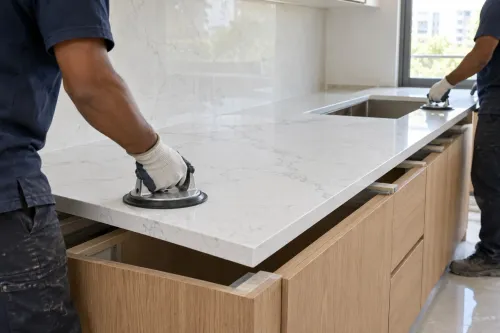
4. Require a final site template after cabinets, panels, appliances and the sink are installed in their final positions. Check cabinet levelling and ask where seams will sit.
Countertops Gallery can be useful when measurement, custom cutting and installation must be coordinated, but judge the provider by the drawing, equipment, support specification and named responsibility—not the sales presentation.
Related service
Kitchen top quartz fabrication and installation Kitchen top quartz fabrication and installation Kitchen Top Quartz Fabrication & Installation – Countertops Gallery, Bangalore Upgrade your kitchen with the elegance and durability of premium... View service → |
When will the slab be available, and who is responsible for site problems?
1. Ask whether the exact slab is in stock and how long the slab reservation lasts. Get written terms for a slab that is sold, becomes a discontinued slab or is damaged before fabrication, including who pays for replacement material. Record the measurement date, templating date, fabrication lead time, delivery date and installation date.
Ask for the process and cost of a remake caused by a measurement error.
2. Make the scope name the person responsible for plumbing disconnection and reconnection, cabinet levelling or reinforcement, wall scribing, wall unevenness, appliance clearances, sink support, hob dimensions, and plumbing or electrical conflicts. Confirm who pays for demolition, disposal, delivery, lifting, backsplash work and changes discovered after fabrication.
The approved drawing must show these responsibilities before you approve cutting.
3. Ask how long adhesives and sealants must cure and when the kitchen can be used again. Before templating, complete cabinet levelling, provide appliance availability and the sink, clear access for lifting, and arrange dust protection.
Ask whether cutting happens off-site or indoors, and require wet cutting, local exhaust ventilation, respiratory protection, housekeeping and documented silica dust control for respirable crystalline silica. Before paying a deposit, obtain the itemised quotation, approved drawing, slab photographs, final measurements, product-specific care instructions and warranty certificate.
What will the warranty cover, and what must I inspect before final payment?
Before paying final balance, get separate written countertop warranty terms for the slab, fabrication and installation. Confirm whether each covers material defects, seam failure, inaccurate templating, cracking during installation, plumbing-related damage and installation defects. Ask who pays for a remake after a chip, crack, wrong cut-out or incorrect seam.
| Check | Ask for | Common exclusion |
|---|---|---|
| Surface | Material defects and staining | Heat damage exclusion, impact damage, staining and chemical damage |
| Fabrication | Seam repair, edge finish and accurate cut-outs | Poor maintenance or unauthorised fabrication |
| Installation | Cracking, sink support and plumbing-related damage | Structural movement, unsupported overhangs, cabinet movement and unauthorised installation |
Complete a finished countertop inspection before signing:
- Check level, seam alignment, edge polish, cut-out clearance, silicone joints, chips and cracks.
- Confirm overhang support and the exact sink and hob fit.
- Photograph damage to cabinets, walls, appliances and the delivered surface.
- Compare the countertop with the approved slab photographs and final drawing.
- Record every defect, the agreed remedy and completion date on the handover sign-off.
Request countertop care instructions for the exact product. Quartz commonly needs mild soap and water, with abrasives, strong solvents and prolonged chemical exposure avoided; porcelain tolerates a broader chemical range, while granite care depends on its stone and finish.
A neutral slab can simplify replacement and future repairs when low visual complexity matters more than Calacatta contrast. Choose porcelain only when its fabrication, handling and support requirements fit the layout and budget.
Frequently asked questions
What details should the written countertop specification include?
It should name the material as resin-based engineered quartz, natural granite or porcelain slab, plus the manufacturer, collection, slab number, lot number, thickness, dimensions, country of origin and reserved slab.
What should a countertop quotation include?
Ask whether it includes the slab, measurement, templating, cutting, edge profile, sink and hob cut-outs, supports, transport, installation, sealing and applicable taxes. Request every exclusion in writing.
How can I confirm the countertop layout will work?
Review the final template for seams, overhangs, joints, sink and hob cut-outs, support requirements, appliance clearances and the fabrication method before production starts.
Who is responsible if the slab is damaged or site conditions cause problems?
Confirm in writing who handles transport damage, incorrect measurements, inaccessible sites, uneven cabinets, wall irregularities, revised templates and replacement fabrication.
What should I inspect before making the final payment?
Check the material and slab identity, colour consistency, seams, edge finish, cut-outs, overhang support, level installation, chips, cracks, stains and visible surface defects. Compare the result with the quotation and warranty.