

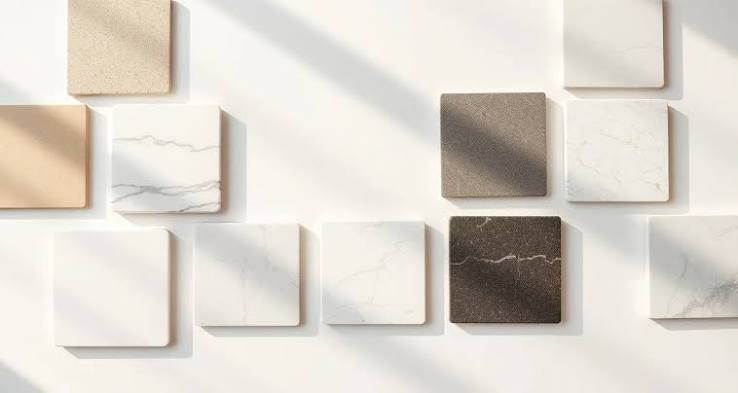
Choosing a quartz brand involves more than matching a white slab to your cabinets. You need to compare the manufacturer’s published specifications, warranty, design consistency, dealer support and suitability for your room before approving a fabricator or paying for material. By the end, you will have a practical shortlist and a checklist for comparing quartz with porcelain, granite and marble.
Key takeaways
- Compare resin formulation, test data, colour consistency and fabrication support.
- Choose porcelain for heat and sunlight; choose granite for natural variation and durability.
- Specify slab finish, thickness, edge profile, cut-outs and seam locations before fabrication.
- Verify warranty exclusions, approved installers, sample accuracy and Bengaluru service support.
What separates engineered quartz brands from one another?
A brand name tells you less than the slab’s formulation, test data, production consistency and support after purchase. Engineered quartz combines mineral aggregate with a polymer resin binder, so compare how each manufacturer manages heat, sunlight, stains, scratches, impact and fabrication—not just colour.
Use this checklist before comparing manufacturers:
1. Ask for the technical data sheet for the exact collection. Check slab thickness, dimensions, water absorption, stain resistance, scratch resistance, impact performance and stated temperature limits. Reject vague claims such as “indestructible” when no test method or value is provided.
2. Confirm the intended environment. Standard interior quartz is not automatically suitable for outdoor kitchens, sunrooms or strong direct sunlight; UV exposure can discolour resin-based surfaces. Choose a product specifically rated for exterior or high-UV use when that condition applies.
3. Review the care sheet and chemical exclusions. Strong solvents, concentrated acids or alkalis, abrasive powders and prolonged contact with staining chemicals can dull or damage the resin surface. A quartz countertop is not maintenance-free or heatproof: use trivets under hot pans, roasting trays and slow cookers.
4. Examine more than a small sample. Ask how the manufacturer controls colour and veining between batches, then approve the actual slabs for a large island or continuous design.
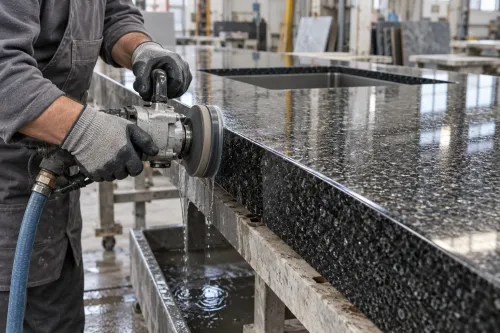
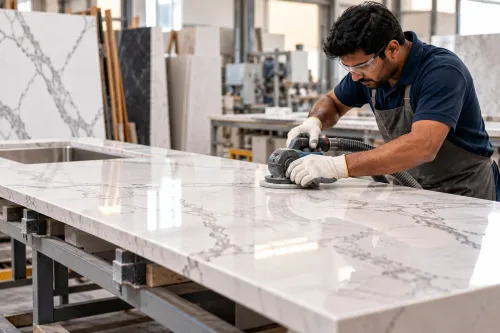
5. Request fabrication guidance covering cutting, edge profiles, sink openings, seams and adhesive colour. A seam is affected by lighting, slab movement, cabinet stability, levelling and installer calibration, so approve its written location before cutting.
6. Read the warranty for exclusions, registration rules, residential limits and dealer responsibilities. Compare local stock, replacement lead times and technical support alongside the slab itself.
Five quartz brands worth putting on a serious shortlist
Five names deserve a serious comparison: Caesarstone, Silestone, Cambria, Vicostone and Quantra quartz. They cover distinct design languages and supply networks, but none should be selected from a brochure alone.
| Brand | Why it belongs on the shortlist | Confirm before ordering |
|---|---|---|
| Caesarstone | Broad contemporary range and established technical documentation | Exact collection, thickness, warranty terms, UV suitability and Bengaluru stock |
| Silestone | Strong choice for dramatic veining and polished modern interiors | Model-specific certification, care limits, slab dimensions and batch consistency |
| Cambria | Premium design-led option for high-visibility kitchens and hospitality-style spaces | Local availability, approved fabricator, warranty eligibility and installation requirements |
| Vicostone | Useful for large-format modern schemes where consistent engineered patterns matter | Matching slabs from one lot, seam guidance, lead time and exact technical sheet |
| Quantra quartz | Indian-market option worth comparing for design, logistics and project coordination | Current model, actual slab inspection, warranty registration and fabrication instructions |
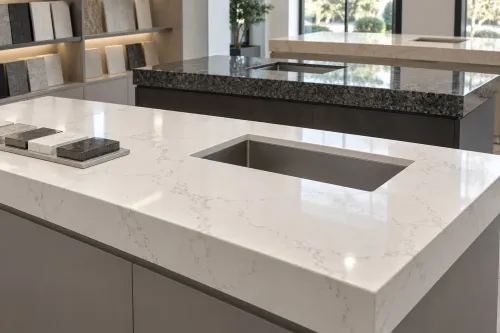
Choose the brand only after inspecting the actual slabs when the island is large, the pattern is prominent or two slabs must align. A small sample cannot show full-surface veining, resin fill, shade variation or movement.
Treat “low-emitting” and “food-safe” as separate claims. Check the certificate against the exact model; NSF/ANSI 51, where applicable, covers specified food-equipment uses and does not prove UV resistance or zero crystalline silica.
Standard interior quartz is not an automatic choice for an outdoor kitchen or sunroom. Ask for an exterior or high-UV rating, and require wet cutting or dust controls during fabrication rather than allowing dry cutting inside an occupied home.
Quartz, porcelain, granite or marble: which surface fits the room?
Choose quartz for a busy indoor kitchen when you want consistent colour, predictable patterning and low routine maintenance. Select porcelain for stronger UV resistance and heat performance, granite for natural variation and heavy-use durability, or marble when veining and patina matter more than easy care.
| Surface | Best fit | Main compromise |
|---|---|---|
| Quartz | Indoor kitchens, bathrooms and coordinated premium interiors | Resin binders can discolor in strong sunlight, suffer heat damage or react to harsh chemicals |
| Porcelain | Sunrooms, outdoor kitchens, high-heat zones and minimalist designs | Lower water absorption and strong UV resistance come with more vulnerable edges and corners |
| Granite | High-use kitchens where natural stone variation and impact resistance matter | Each slab differs, and sealing and periodic maintenance may be part of ownership |
| Marble | Baking areas, statement islands and interiors where distinctive veining is the priority | Acids etch it, porous areas can stain, and scratches or patina remain visible |
In quartz vs porcelain, porcelain wins for direct sun and hot cookware, while quartz usually offers easier edge fabrication and a more forgiving installation process. In quartz vs granite, quartz provides greater visual consistency; granite provides genuine natural-stone character.
In quartz vs marble, quartz is the practical choice for frequent spills, while marble rewards you for accepting maintenance.
Do not treat “food-safe” as a material assumption. Check the exact product’s certification or test result, such as NSF/ANSI 51 for applicable food-equipment uses. Ask how fabrication will control respirable crystalline-silica dust: wet cutting, local exhaust and proper occupational-safety controls are essential for quartz, porcelain and granite.
Turn a brand shortlist into a fabrication-ready specification
Make the quote a fabrication document, not a price per square foot: require the slab series, batch or lot, slab thickness, slab dimensions, finished edge, cutouts, seams, backsplash, support plan, delivery and installation scope.
1. Confirm the selected slab can cover the layout. Record slab dimensions and orientation, then approve a cutting diagram showing grain or veining direction, sink cutout, cooktop cutout, backsplash pieces and every seam. A second slab can change colour or pattern continuity.
2. Approve seam locations before fabrication, because seam visibility has no universal guarantee. Colour, veining, lighting, adhesive shade, cabinet movement and leveling affect the result; reject a layout that puts a seam beside a sink or in the strongest visual focal point unless you accept it.
3. Specify the visible edge separately from slab thickness. A 20-mm or 30-mm slab may receive an edge build-up, and the laminated joint can show on directional patterns. Name the profile and finish.
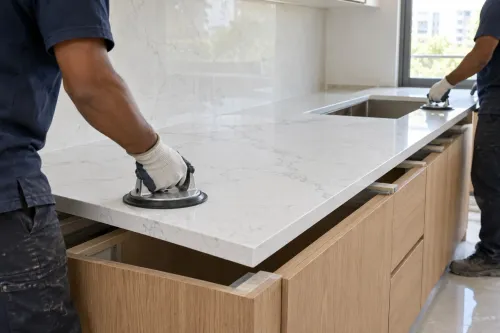
4. Put the sink cutout and cooktop cutout details in writing, including eased or radiused inside corners, reinforcement and polishing. Confirm cabinets are level and supported; overhang support must be calculated for depth, thickness, cutouts and cabinet geometry, with brackets, corbels or substrate named.
5. Confirm site access, delivery inspection, installation, sealing where applicable and warranty exclusions. Ask for the product’s specific food-contact certification or test result, such as NSF/ANSI 51, rather than relying on “food-safe.” Countertops Gallery can use this approved drawing to align fabrication and installation instead of guessing on site.
Related services
Quartz . View service → |
Quartz . View service → |
How to compare warranties, samples and Bengaluru dealer support
A chosen quartz brand earns your confidence through documents, matching samples and accountable installation—not a showroom label. Read the quartz warranty before paying: confirm the covered product series, duration, transfer rules, exclusions for heat, chemicals, chips and poor support, and the claim process after installation.
| Evidence | What to verify | Why it matters |
|---|---|---|
| Brand documentation | Warranty names the exact series and model; food-contact certification states its intended use; NSF/ANSI 51 and any low-emitting certification match that model number | A certificate for another product does not protect your slab |
| Slab and sample | Sample colour, veining and finish match the delivered slab; record lot or batch details and inspect edges, cutouts and seams before acceptance | Batch consistency failures become obvious only after fabrication |
| Dealer and fabricator | Bengaluru availability includes the selected series, written support plans, care instructions and a named contact for defects | A distant replacement slab can delay the project and alter the colour |
- Ask the dealer to confirm the slab’s lot number, thickness and inspection procedure in writing. Keep photographs before cutting.
- Require a drawing showing seam positions, sink and cooktop cutouts, edge profile, overhang depth and brackets or substrate support. Generic overhang limits ignore cabinet geometry and cutout stress.
- Check that the handover documents identify approved cleaners. Strong solvents, abrasive powders and concentrated acids can damage resin surfaces even when the quartz warranty remains valid.
- Reject vague promises such as “food safe” or “scratch proof.” Demand the certificate, test scope, exclusions and claim route tied to your exact slab.
Frequently asked questions
What separates engineered quartz brands from one another?
Compare mineral-to-resin formulation, heat, stain, scratch and impact testing, colour consistency, slab availability and fabrication support.
How do quartz, porcelain, granite and marble differ?
Quartz offers consistent design and low routine maintenance; porcelain handles heat and sunlight well; granite provides natural variation; marble delivers distinctive veining but needs more careful stain and etch management.
What belongs in a fabrication-ready countertop specification?
Record the selected brand and colour, slab thickness, finish, dimensions, edge profile, sink and hob cut-outs, supports, seam locations and backsplash details.
How should you compare quartz warranties and Bengaluru dealer support?
Check the warranty period, registration rules, exclusions, transfer terms and approved installer requirements, then confirm samples, stock, lead times, fabrication and after-sales contacts locally.
Related services
Quartz . View service → |
Quartz Calacatta Black & White Dongri . View service → |
Quartz . View service → |
Quartz . View service → |