


A quartz slab can crack, separate at a seam, damage a cabinet, or fail around a sink when the supporting structure, measurements, transport, or cut-outs are wrong. You will learn how to assess installation risk, compare quotations, prepare your Bangalore kitchen, inspect the finished work, and decide when professional installation is worth the cost.
Key takeaways
- Confirm cabinets are firmly fixed and level before templating.
- Compare written quotations for templating, cut-outs, seams, transport, and installation.
- Inspect seams, edges, cut-outs, and cabinet support before signing handover.
- Report rocking slabs, cracks, chips, or open seams promptly after installation.
How Installation Quality Determines Quartz Countertop Life
A durable quartz slab can fail because quartz countertop installation quality determines how loads reach the cabinets beneath it. Base units must be firmly fixed, level, and joined to a level substrate before templating; movement or deflection makes slabs rock, creates uneven surfaces, opens seams, detaches edges, cracks corners, chips cut-outs, and damages cabinets.
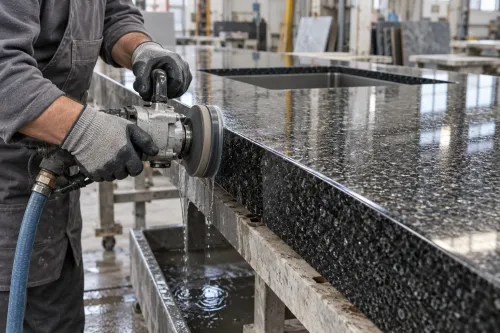
Safe installation depends on clean, accurately prepared joints, a suitable adhesive, correct quartz seam placement, and adequate curing time before loading the surface. Rounded internal corners at sink and hob cut-outs reduce stress concentration, while undermount and heavy sinks need dedicated support fixed to the cabinet or a concealed frame.
Adhesive alone should not carry the sink.
There is no universal safe overhang measurement. The limit depends on slab thickness, geometry, cabinet support, brackets, and concealed frames, so use the selected slab’s technical guide. Seams are not automatically defects, but layout, color, lighting, edge profile, and leveling determine how visible they remain.
- Check that cabinets do not move, the substrate is level, and long spans have continuous support.
- Confirm cut-out corners are radiused, edges are sealed where required, and sink supports are mechanically secure.
- Treat concentrated heat, thermal shock, heavy impacts, and direct hot cookware as risks; heat can damage resin and impacts can chip edges or openings.
- Allow adhesive and seams to cure before reconnecting equipment or placing heavy appliances.
What Happens During a Professional Quartz Installation in Bangalore
A professional visit begins only after base cabinets and panels are fixed, level, and adequately supported. The installer checks wall irregularities, access routes, and the finished position of every component; quartz templating from drawings or unfinished cabinets leads to wrong clearances, appliance clashes, and unusable sink and hob cut-outs.
- Confirm appliance dimensions, sink type, hob position, backsplash thickness, overhangs, and final cabinet alignment. Have the sink, hob, and appliances available, or provide their exact manufacturer specifications.
- Record the template after cabinets, panels, sink, and appliances reach their final positions. Mark joints, wall deviations, rounded cut-out corners, and clearances on the drawing.
- Plan Bangalore countertop installation around narrow entrances, apartment lift access, stair width, slab weight, and protective wrapping. Reserve lift time and remove doors or appliances that block the route.
- Fabricate and finish the pieces off-site, then transport them upright with controlled handling. Keep the kitchen dry during monsoon work; moisture in unfinished walls or cabinets can damage MDF even when quartz resists water.
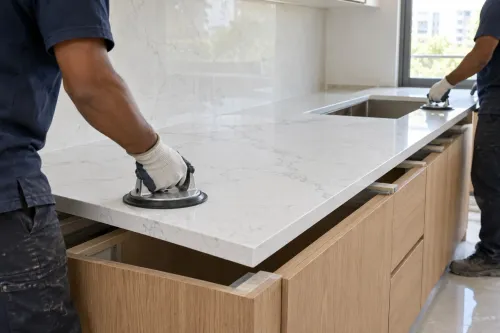
- Dry-fit every piece before bonding. Check level, wall contact, seams, sink and hob cut-outs, overhang support, and backsplash fit before applying adhesive.
- Bond the slabs, seal joints and wet-area edges, and control dust so grit does not enter adhesive or plumbing connections. Coordinate carpenters, plumbers, electricians, and appliance installers rather than letting one trade alter another’s measurements.
- Reconnect plumbing and equipment only after adhesives and sealants have cured for the installer’s stated time. Keep the surface unloaded during that period, then inspect level, seams, cut-outs, sink stability, edges, and water flow at handover.
Plan for kitchen downtime, appliance removal, curing, and a clean access path—not just slab delivery.
How to Compare Installers, Quotations, and Responsibility
A capable installer proves control before cutting the slab. Request a measurement drawing, seam plan, edge-profile sample, recent references, insurance details, installation warranty, repair policy, and the name of the person responsible when fabrication errors appear.
Your quartz installation quotation must state:
- Slab thickness, seam number and locations, edge profile, sink and hob cut-outs
- Backsplash pieces, transport, lifting, installation, and plumbing disconnection and reconnection
- Taxes and every excluded task, including cabinet alterations, appliance removal, electrical work, and wall repairs
| Option | Price | Precision and scheduling | Responsibility and warranty |
|---|---|---|---|
| Coordinated professional installation | Highest upfront cost | Templating, fabrication, transport, and fitting are coordinated; fewer site surprises | One accountable provider, documented installation warranty |
| Cheaper fabricator | Lower price | Fabrication may be separate from access, cabinets, or plumbing; delays can shift between trades | Disputes over damage or fit; warranty may cover the slab but not installation |
| Carpenter-led installation | Mid-range | Carpenter coordinates cabinetry, but stone tolerances and seam finishing need specialist control | Responsibility can split between carpenter and fabricator |
| DIY quartz countertop | Lowest labour cost | Heavy slabs, precise cut-outs, lifting, leveling, and bonding create high error risk | You carry the damage, repair, and warranty risk |
Professional service is poor value for a temporary kitchen, unstable cabinets, a layout due to change, or an inaccessible site that needs major lifting arrangements. Choose another surface when your priorities are extreme heat resistance, impact tolerance, outdoor exposure, or a tighter budget.
Which Design and Site Decisions Prevent Installation Problems
Confirm final positions and structural conditions before fabrication; otherwise a precise slab can still arrive with the wrong cut-outs, unsafe overhangs, or a seam in the worst place.
Your site record should confirm:
- Cabinets and panels are fixed, level, aligned, and fully supported—not merely installed in their unfinished state.
- The actual sink, hob, appliances, tap holes, and service clearances are present or matched to final manufacturer dimensions.
- Wall irregularities, backsplash thickness, and the finished wall line are measured, so the rear edge does not force the slab out of position.
- Quartz vein direction, slab layout, edge details, and seam position are approved before cutting.
- Narrow doors, apartment lifts, stairs, turns, and temporary obstructions can accommodate the fabricated pieces.
| Decision | Avoid | Why |
|---|---|---|
| Seam position | Sink or hob opening | Cut-outs weaken the slab; a seam there adds stress, visible joint movement, and repair difficulty. |
| Measurement timing | Unfinished cabinets | Cabinet changes can misalign walls, appliances, and sink or cooktop cut-outs. |
| Breakfast counter overhang | Unsupported projection | Deflection can crack edges or detach the slab; brackets or a concealed frame may be required. |
Sink and hob openings need adequate clearance, smooth radiused internal corners, and dedicated sink support where the bowl is heavy. Confirm the technical support requirement for long overhangs, waterfall end support, and any unsupported joints.
During a Bangalore kitchen renovation, Countertops Gallery can record these measurements, layout approvals, transport constraints, support details, and installation responsibilities before fabrication. That coordination—not quartz supply alone—connects safe design with a fitting finished countertop.
Related services
Kitchen top quartz fabrication and installation Kitchen top quartz fabrication and installation Kitchen Top Quartz Fabrication & Installation – Countertops Gallery, Bangalore Upgrade your kitchen with the elegance and durability of premium... View service → |
Quartz . View service → |
How to Inspect, Care For, and Resolve Problems After Handover
Photograph the finished surface before using it and record the handover date for your quartz countertop inspection. Check that the slab is level without rocking, seams are tight and reasonably inconspicuous, edges are uniform, cut-outs have even clearance and rounded internal corners, and walls touch consistently without forcing the slab.
1. Press gently around the sink and inspect its rim, clips, brackets, or support frame. An undermount or heavy sink must not hang from adhesive alone. Check that overhangs have brackets or a concealed frame where required, wet-area joints have continuous sanitary sealant, and cabinets do not move when doors or drawers close.
2. Wait for the installer’s stated adhesive and seam-curing period before placing appliances, reconnecting plumbing, or loading a breakfast bar. For quartz care after installation, lift objects rather than dragging them, use trivets or heat pads under pans, oven trays, and heat-producing appliances, and protect corners from impacts.
3. Remove adhesive residue with a plastic scraper and a manufacturer-approved stone cleaner on a soft cloth. Do not use abrasive powders, steel wool, concentrated acids, alkalis, or harsh solvents.
4. Describe the failure accurately when seeking a quartz repair warranty: unevenness, open seams, poor support, loose sinks, or bad sealant indicate installation defects; cracks from delivery indicate transport damage; shifting cabinets indicate movement; stains, burns, or impact chips indicate misuse. A slab fault requires material assessment.
- Approve the work only if cabinet quality, support design, handling, thermal-shock protection, impact avoidance, cleaning, and maintenance are documented.
- Choose porcelain, granite, or another surface when extreme heat, direct sunlight, severe impact, or a lower budget outweighs quartz’s advantages.
Frequently asked questions
How does installation quality affect quartz countertop life?
Firm, level cabinets and a stable substrate distribute loads evenly. Movement or deflection can cause rocking, open seams, detached edges, cracks, chips, and cabinet damage.
What happens during professional quartz installation in Bangalore?
The installer checks site conditions, verifies cabinet support and levels, creates a template, plans seams and cut-outs, transports the slabs, installs them, and completes an inspection.
How should you compare quartz installation quotations?
Check whether each quotation clearly assigns responsibility for templating, transport, cut-outs, edges, seams, installation, protection, and post-handover defects.
Which site decisions help prevent quartz installation problems?
Complete and secure the cabinets first, provide a level substrate, confirm appliance and sink dimensions, and agree on seam and cut-out positions before fabrication.
Related services
Quartz Calacatta Black & White Dongri . View service → |
Quartz . View service → |
Quartz . View service → |
Quartz Calacatta Miracle View service → |