

A low quotation does not tell you who owns the slab, who will cut it, or who will fix a failed seam or damaged edge. By checking the supplier’s role, slab evidence, fabrication process, measurements, contract and warranty, you can compare quotations on quality and accountability rather than price alone.
Key takeaways
- Separate slab maker, seller, fabricator, and installer responsibilities.
- Inspect the actual slab for shade, veining, batch, and surface defects.
- Confirm seam locations, cutouts, edge profiles, and reinforcement before fabrication.
- Require itemised measurements, installation scope, exclusions, and warranty terms.
Which type of quartz supplier are you actually hiring?
Before requesting a quote, identify four separate responsibilities: who makes the slab, who holds or sells it, who cuts and polishes it, and who installs it. One company may handle all four, but do not assume that from a showroom sign.
| Party | Confirm before requesting a quote | Why it matters |
|---|---|---|
| Slab manufacturer | Brand, collection, product name, nominal thickness, batch or lot, and warranty document | Engineered quartz differs from granite and porcelain in cutting, heat behaviour, support, and repair |
| Quartz distributor | Stock location, slab availability, storage condition, and responsibility for transport or damage | A catalogue image does not prove the exact slab is available or undamaged |
| Stone fabricator | Workshop address, equipment, edge-finishing capability, and who handles cutouts and joins | Poor fabrication creates chips, cracks, uneven edges, and visible seams |
| Stone fabricator and installer | Whether the same team templates, cuts, transports, installs, and rectifies defects | Divided responsibility makes mistakes harder to resolve |
| After-sales provider | Legal entity issuing the warranty, response contact, exclusions, and removal or reinstallation terms | A verbal promise is difficult to enforce after installation |
Ask for these names in writing on the quotation. It should identify the actual material rather than “stone,” state slab thickness and finished build-up, and specify whether any task is subcontracted. Confirm who returns for a failed seam, cracked cutout, transport damage, or installation defect before paying a deposit.
How can you verify the actual slab rather than trust a showroom sample?
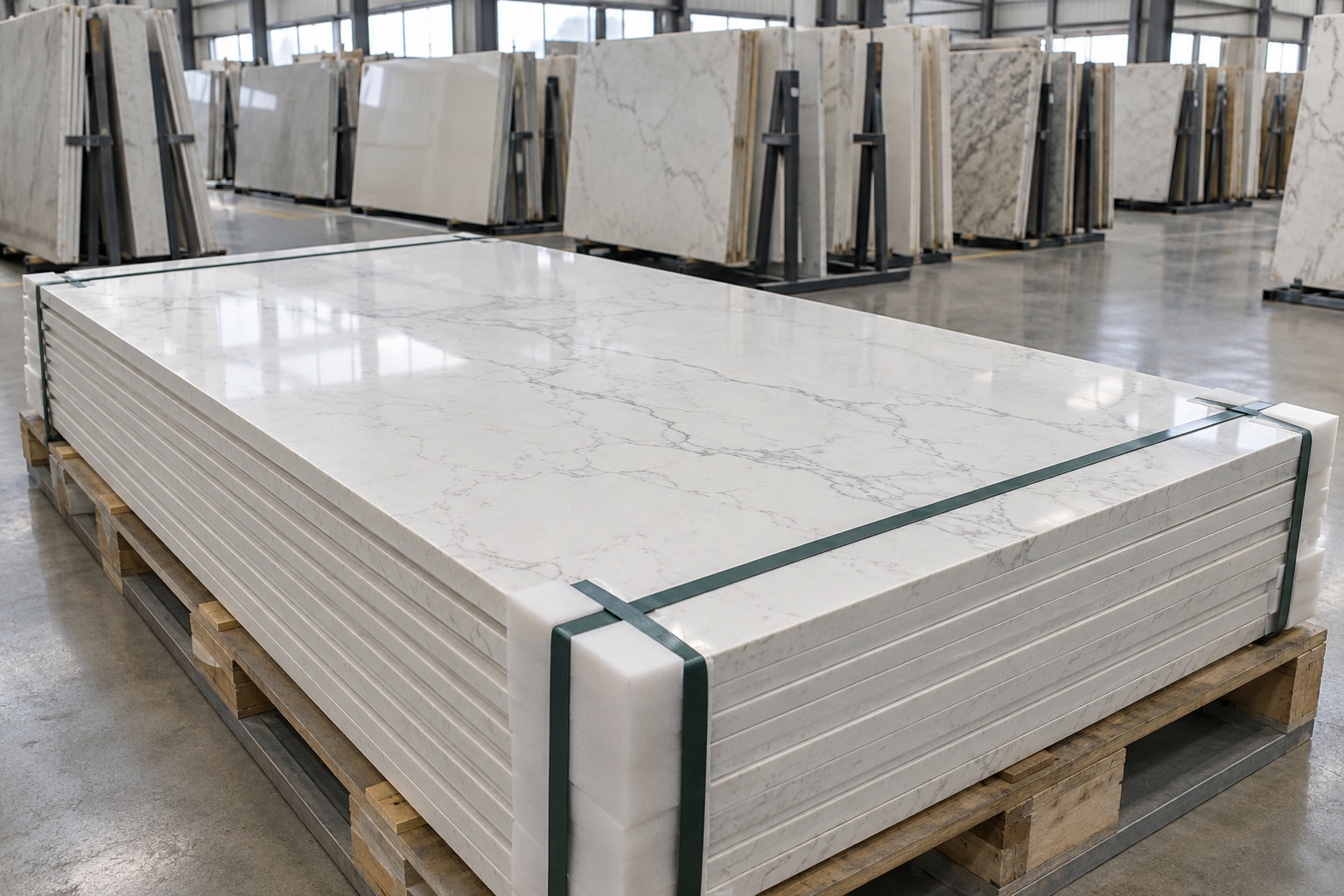
Approve the exact slab before fabrication if colour, veining, or aggregate distribution matters. A small showroom sample cannot prove the full slab will match. View the slab in daylight, then compare it with the approved sample under your kitchen’s lighting.
| Inspection point | What to compare or inspect | Evidence to record |
|---|---|---|
| Shade consistency | Full slab against the sample and adjacent slabs | Photos in daylight and room lighting |
| Pattern and veining direction | Vein flow, printed movement, bookmatching potential, and proposed joins | Marked layout showing piece orientation |
| Finish | Gloss level, reflective patches, resin marks, pinholes, scratches, and polishing variation | Close-up photographs and written finish approval |
| Condition | Corners, edges, chips, cracks, warping, and handling damage | Slab photographs with defects circled |
| Thickness | Caliper measurement against the quoted nominal thickness, such as 20 mm or 30 mm | Measured value, finished build-up, and edge detail |
| Batch consistency | Shade and pattern across slabs from the same production run | Batch number and lot traceability |
Complete a quartz slab inspection before signing the cutting approval. Check the reverse side for the manufacturer’s label, then photograph the label and every visible defect. Ask the supplier to confirm that replacement pieces will come from the same batch; a later lot can have a different shade or surface finish.
Keep the signed layout with the slab photographs. It should identify cutouts, seams, vein direction, and any bookmatched pieces. Do not approve “seamless” as a substitute for seam locations.
Can the supplier execute your custom countertop design safely?
Ask for a dimensioned fabrication drawing before approving a custom quartz countertop design. It should show seam positions, vein direction, finished thickness, supports, cutouts and edge details, not merely a computer-rendered kitchen view.
Require the drawing to identify:
- Bookmatching quartz slabs, with the planned mirror line and extra slab allowance
- The waterfall edge, including mitre direction, corner support and floor clearance
- Each mitred join, its location, seam width and method of reinforcement
- Curved cuts, with the radius and finished edge treatment
- The undermount sink cutout, sink model, corner radius and support rail
- Hob openings, minimum edge distances and heat-clearance details
- Drain grooves, their depth, fall and distance from the sink
- Backsplash returns, including height, internal corners and seam positions
Ask to see two or three completed projects with these features, then inspect close-up photographs of joins and cutout corners. A supplier that cannot explain its tooling, polishing sequence, continuous support and handling procedure is not ready for delicate fabrication.
Confirm who will cut the slab and whether the approved fabricator handles repairs. Thin porcelain formats such as 6 mm or 12 mm need stricter support and handling than common 20 mm or 30 mm quartz; edge chips and failed cutouts become expensive after installation.
Get the nominal slab thickness, finished build-up and substrate requirement in writing before paying a deposit.
What checks prove the measurement and installation process is under control?
A controlled process leaves an approval trail from cabinet measurement to sealed seam. Ask the supplier to show you the drawing, machine file, inspection record and installation sign-off, not only finished photographs.
1. Confirm the site template records wall angles, cabinet levels, appliance clearances, sink and hob models, seam positions, overhangs and support points. For digital templating, compare the on-site scan or measured CAD file with the approved drawing before fabrication; do not approve dimensions from a verbal measurement.
2. Check that CNC quartz cutting or waterjet cutting uses that approved file. The supplier should mark cutouts, radii, mitred joins and finished edges on the layout, then identify each piece so orientation cannot be reversed.
3. Inspect a finished edge sample under direct light. Look for consistent polish, a clean radius, no resin pits, chips, burn marks or visible laminate line. Confirm the finished build-up separately from the nominal slab thickness.
4. Ask how workers control respirable crystalline silica. Wet cutting, local exhaust, filtered vacuuming and a documented respiratory-protection procedure matter; OSHA’s eight-hour exposure limit is 50 micrograms per cubic metre. Dry sweeping is a warning sign.
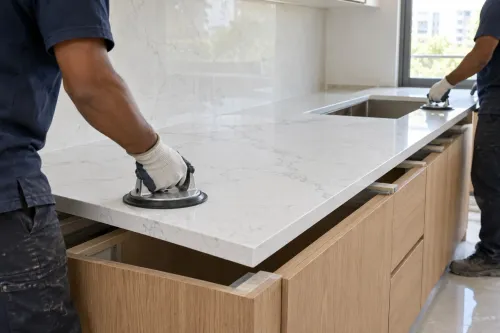
5. Require a dry fit before adhesive or plumbing reconnection. Check wall gaps, seam tightness, level, overhang support, sink seating, hob clearance and backsplash returns against the drawing.
6. Use a quartz countertop installation checklist for final sign-off, including chip inspection, seam colour, silicone, cleaning, appliance fit and care instructions. Countertops Gallery should provide these records with the handover, not after a defect appears.
Related services
Kitchen top quartz fabrication and installation Kitchen top quartz fabrication and installation Kitchen Top Quartz Fabrication & Installation – Countertops Gallery, Bangalore Upgrade your kitchen with the elegance and durability of premium... View service → |
Quartz . View service → |
What must the quotation and warranty promise before you choose?
Reject any quartz countertop quotation that says only “stone” and gives one lump sum. Compare the complete scope, because omitted supports, backsplash work, delivery, plumbing reconnection or defect remediation can erase an apparent saving.
| Item | Confirm in the quotation | Risk hidden by a low price |
|---|---|---|
| Material | Product name, colour, finish, nominal thickness and suitability near heat or outdoor cooking | Substituting porcelain, granite or a different quartz without approval |
| Fabrication | Edge profile, cutouts, seam locations, backsplash height and polishing | Unfinished edges, sharp sink corners or extra joins |
| Support | Overhang depth and the specified brackets, legs, corbels or steel frame | Cracks from unsupported breakfast bars or islands |
| Installation | Template date, installation date, dry-fit, levelling and final sealing | Separate charges for fitting, adjustments or damage repairs |
| Service | Delivery, waste removal, plumbing reconnection and named defect response | You become responsible after payment |
Put every design decision in the contract: sink and cooktop models or cutout responsibility, change-order prices, payment milestones and who owns measurement errors. Require the fabricator to state the manufacturer’s minimum material around openings and the required corner radius.
Read the quartz warranty exclusions before signing. They should address cabinet movement, inadequate support, impact, thermal damage, stains, misuse and structural movement, while separating material defects from fabrication and installation defects. An installation warranty must name who returns, the response period, and whether removal and reinstallation are covered.
Obtain the quartz care guide, and check whether the manufacturer requires an approved or qualified installer.
Frequently asked questions
Which type of quartz supplier are you actually hiring?
Identify whether the company manufactures, sells, stores, fabricates, installs, or manages subcontractors for the slab.
How can you verify the actual slab rather than trust a showroom sample?
Inspect the reserved slab in person and record its brand, colour, batch details, dimensions, finish, and visible defects.
Can the supplier execute your custom countertop design safely?
Review the approved drawing for seams, overhangs, sink and hob cutouts, edge profiles, joints, and required reinforcement.
What checks prove the measurement and installation process is under control?
Confirm a site measurement visit, final approval drawing, installation date, access plan, level cabinets, seam layout, and post-installation inspection.
What must the quotation and warranty promise before you choose?
Require an itemised quote covering slab grade, fabrication, cutouts, edges, transport, installation, taxes, exclusions, defects, damage, and warranty remedies.
Related services
Quartz . View service → |
Quartz . View service → |
Quartz . View service → |
Quartz . View service → |