

A nearby granite supplier is not automatically the best choice: search ranking and a low square-foot rate reveal little about stock ownership, slab quality, fabrication skill, or the work included in the final price. By comparing the supplier, the actual slab, the written scope, and the templating process, you can choose a team that delivers the stone and fitment your renovation requires.
Key takeaways
- Visit the supplier’s stockyard and workshop before paying a deposit.
- Compare full slabs for colour, veining, thickness, cracks, and repairs.
- Make every quotation list measurement, edge profile, cut-outs, transport, and installation.
- Record the selected slab, warranty, seam plan, and responsibility in writing.
Confirm the supplier’s stock, workshop, and accountability
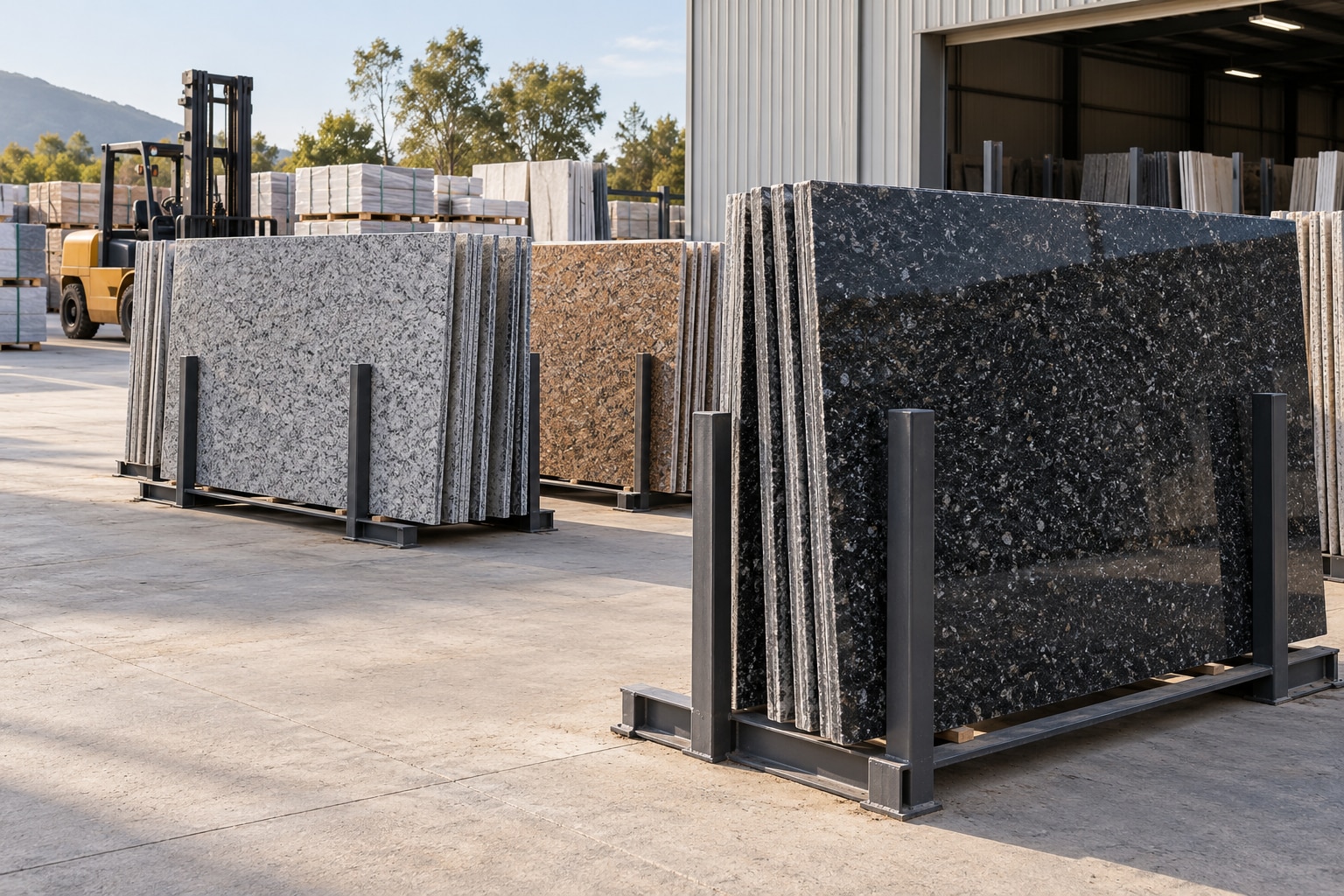
A granite supplier near me is not necessarily a granite fabricator. Verify the operation before paying a deposit: visit the yard or warehouse, inspect labelled slabs, and ask whether the displayed granite stock belongs to the supplier or is ordered from another dealer after you approve a design.
Request these records and observations:
- A current slab identification showing thickness, finish, manufacturer or quarry, and lot or bundle number. A vague colour name is not proof of stock.
- A visit to the granite fabrication workshop, where you can see cutting, polishing, edge profiling, and dust-control equipment in use. Ask whether the employees performing the work are the supplier’s staff or a named subcontractor.
- A written quote naming the legal business that will measure, fabricate, deliver, install, and accept complaints. If a third party performs one stage, the quote must identify that company and responsibility for damage.
- Current general-liability and workers’ compensation insurance, a written labour warranty, and a process for reporting chips, cracks, poor seams, or incorrect fit.
Use granite supplier verification to separate genuine inventory from catalogue brokerage. A supplier that cannot show the slab, bundle number, workshop, or responsible installer before taking your deposit deserves comparison with another candidate.
For an undermount sink, put the cutout, polishing, sink installation, clips or rails, and plumbing reconnection in writing. Provide the exact sink model at templating; its rim geometry determines the opening. Also confirm whether sealing is included, which sealer is used, and the recommended resealing interval for that granite.
Compare the actual slabs, not just names and samples
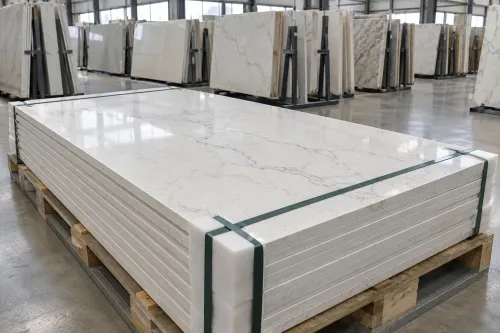
Inspect the actual slab, or a current slab from the same lot, before requesting a final quote. A small sample cannot show full-slab movement, veining, shade shifts, fissures, resin patterning, or whether two pieces will match across a seam.
Ask the supplier to record these details in writing:
- Granite varieties, quarry or manufacturer, lot or bundle number, and available granite slab sizes
- Granite thickness, finish, and proposed granite finishes and edge profiles
- Slab count, usable dimensions, cutout limitations, and whether remnants or book-matched pieces are included
- Sealer product, if sealing is included, because granite absorbs differently and sealer slows staining rather than making stone impervious
| Feature | Natural variation | Possible defect |
|---|---|---|
| Fissure | A narrow natural line with no opening, movement, or sharp break | A crack that opens, crosses an edge, changes level, or continues through the slab |
| Pits and resin | Small pits or resin-filled areas disclosed before approval | Unlisted repairs, loose filler, chipped edges, or repairs visible from normal standing distance |
| Backing and surface | Mesh backing used for reinforcement, with cutting limits explained | Unreported mesh, warping, water marks that remain, or a slab that rocks on a flat surface |
| Colour and lot | Shade differences within one bundle disclosed for approval | Mismatched lot numbers or pieces whose colour cannot be accepted together |
Run your hand and a straightedge over the slab under bright light. Photograph approved slabs and their bundle numbers; otherwise, a different piece can arrive after you compare the quote.
Make competing quotations use the same scope
Compare a granite countertop quotation only after every supplier prices the same work. A low granite fabrication cost can disappear once another quote adds cut-outs, delivery, or tax separately.
| Item | Quote A | Quote B | Confirm |
|---|---|---|---|
| Templating | Included or separate | Included or separate | Site measurement and template date |
| Material | Full slab or remnant | Full slab or remnant | Thickness, finish, lot number, waste charge |
| Fabrication | Base price | Base price | Edge profile, polishing, seams, granite cut-outs |
| Installation | Included or separate | Included or separate | Granite installation scope, supports, levelling |
| Sink and fittings | Cutout only | Cutout, clips, sink fitment | Undermount polishing, rails, faucet holes, plumbing reconnection |
| Site work | Demolition, disposal | Not included | Old countertop removal and debris disposal |
| Logistics | Delivery included | Delivery extra | Stairs, narrow access, lifting, and protection |
| Extras | Backsplash and tax | Backsplash and tax | GST or other tax shown as a separate line |
Ask each supplier to issue a revised written quote using identical quantities and measurements. Do not accept “installation included” without seeing whether it covers support brackets, seam joining, sink installation, and plumbing; those omissions create the most disputed add-on bills.
Give the sink model before templating. Its rim shape determines the opening, and a sink supplied later may not fit a finished granite cutout. Also confirm whether sealing is included, name the sealer, and record the recommended resealing interval for that stone.
Understand templating, seams, supports, and fitment timing
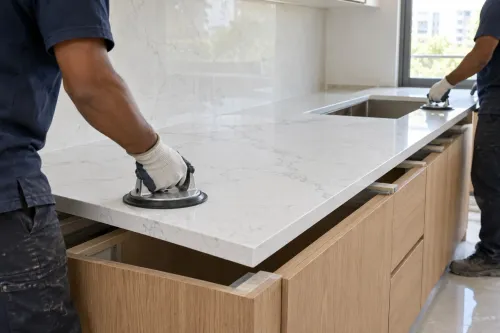
The installation date is provisional until granite countertop templating confirms the finished wall line, cabinet positions, sink model, hob dimensions, and appliance clearance. A later cabinet move or appliance change can force a remake, delay fitment, or leave an inaccurate opening.
| Check | Effect on price or installation date |
|---|---|
| Cabinets and walls | Uneven cabinets or unfinished walls require scribing, levelling, fillers, or remeasurement. A changed cabinet layout can trigger fabrication charges. |
| Sink model | The sink must be available at templating. Its rim geometry affects the sink cut-out, polishing, clips or rails, and undermount fit. |
| Hob and appliances | Confirm the hob cut-out and appliance clearance before fabrication. A changed cooktop or insufficient dishwasher gap can require recutting or cabinet work. |
| Overhangs and gaps | Unsupported breakfast bars, sink rails, and dishwasher gaps need a documented support plan. Extra steel, brackets, or panels add cost and time. |
Approve granite seam placement before fabrication. Slab dimensions, veining direction, cabinet layout, openings, and access to the room determine the practical position. A cheaper quotation can place a seam beside the sink or in a highly visible, vulnerable area rather than provide better value.
Make every supplier price the same written scope. Require separate amounts for templating, cut-outs, edge finishing, seam work, supports, backsplashes, delivery, difficult access, plumbing reconnection, and tax. Also state who pays for remeasurement or remake costs when the site is not ready.
Put the final material, warranty, and responsibility in writing
Before you approve, require one written scope covering the exact stone, workmanship, warranty, and responsibility for damage.
1. Record the granite slab identification: manufacturer or quarry, lot or bundle number, slab thickness, finish, and approved slab photographs. State whether the finished edge uses laminated buildup; countertop thickness is not proof of solid-stone thickness.
2. Attach the final drawing with dimensions, cutouts, edge profiles, overhangs, support requirements, and seam locations. Approve the seam plan before fabrication, because moving a seam away from a sink or visible vein can change both waste and price.
3. Specify granite sealing: who applies it, which product is used, when it is applied, and what maintenance the granite warranty covers. Ask for technical data such as water absorption, density, compressive strength, or flexural strength instead of accepting “commercial grade.”
4. Write separate obligations for fabrication, delivery, and installation. Include the labor warranty, reporting deadline, repair or replacement process, granite installation insurance and damage responsibility, and exclusions for movement, misuse, or third-party damage.
A local fabricator becomes a useful comparison candidate when it can show the actual slab or current lot, explain its test and care documents, and provide current insurance evidence. Countertops Gallery belongs on that comparison list only if its written quote lets you compare those details against other fabricators on equal terms.
Frequently asked questions
How can you verify that a granite supplier is accountable?
Visit the yard or warehouse and workshop, inspect labelled slabs, and ask whether the displayed stock belongs to the supplier or another dealer. Confirm who handles fabrication, delivery, installation, defects, and warranty claims.
Why should you compare full granite slabs instead of names or samples?
Granite varies between slabs in colour, veining, thickness, cracks, repairs, and surface finish. Inspect and approve the actual slabs reserved for your project.
What should comparable granite quotations include?
Ask each supplier to list the granite grade and slab quantity, measurements, thickness, edge profile, sink and hob cut-outs, backsplash, transport, installation, taxes, wastage, and any extra charges.
What must be written into the granite order?
Record the selected slab identification, dimensions, finish, edge profile, cut-outs, seam locations, support requirements, installation timing, warranty terms, payment schedule, and responsibility for damage or poor fitment.