


Porcelain slabs combine a dense, kiln-fired ceramic body with large-format designs that suit clean-lined kitchens, bathrooms and statement interiors. By comparing their performance, limitations, applications and installation demands, you can decide whether porcelain fits your space, lifestyle and site conditions.
Key takeaways
- Choose porcelain for low water absorption and large-format visual continuity.
- Compare heat, staining, repairs and edge fabrication—not just appearance.
- Reject porcelain for designs needing complex edges or frequent impact resistance.
- Confirm slab handling, substrate support, cut-outs and installation details before work begins.
What porcelain slabs are made from—and why that matters in a modern interior
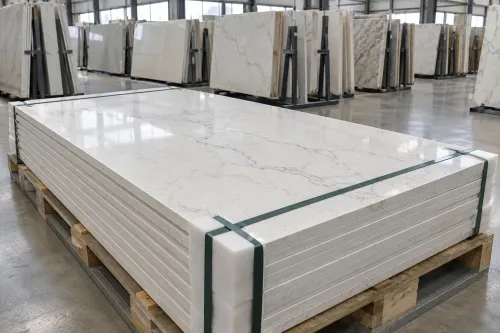
Porcelain slabs are architectural panels made from refined mineral powders, pressed into large sheets and kiln-fired into dense fired porcelain. Their mineral composition produces very low water absorption without the polymer binder used in quartz.
They share a ceramic family with porcelain tableware, but slabs are engineered for flat worktops; plates and cups are shaped for vessels, not cabinet support or cut-outs.
| Material | Made from | Why the difference matters |
|---|---|---|
| Large-format porcelain slabs | Mineral powders, pressed and kiln-fired | Low absorption, UV stability, heat tolerance and consistent printed patterns. |
| Porcelain tableware | Ceramic body formed into vessels | Similar family, but not designed for worktop loads, spans or cut-outs. |
| Quartz | Quartz particles plus polymer resin | Predictable colours and fabrication; concentrated heat can damage resin. |
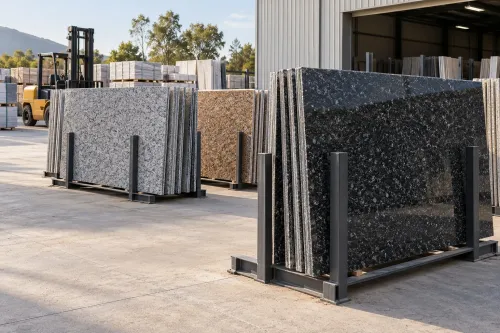
| Granite | Quarried igneous rock | Natural depth and variation, with robust thick-edge details. |
| Marble | Quarried carbonate stone | Distinct veining and depth; acids can etch it. |
| Sintered stone | Engineered minerals compacted and sintered | Related panel category; formulations and performance vary. |
That composition suits contemporary interiors: one large sheet gives longer visual runs with fewer joints, while printing can imitate concrete or stone without unpredictable veining. The trade-off is brittle handling. Large-format porcelain slabs need cabinet support, diamond tooling and controlled cut-outs; rushed cuts or sharp corners can chip edges or crack the panel.
For porcelain slabs Bangalore projects, fabricator experience with the exact slab system matters as much as the design.
Porcelain versus quartz, granite and marble: which surface performs better?
A simple choice rule is this: choose porcelain for heat, sunlight and consistent patterning; quartz for predictable fabrication; granite for natural depth and substantial edges; marble for veining, accepting more maintenance. That is the practical difference in porcelain versus quartz, granite and marble.
Surface | Heat and sunlight | Stains, scratches and sealing | Pattern, repairs and edges Porcelain | Handles hot cookware and strong UV exposure better than resin-bound quartz; use a trivet against thermal shock. | Very low absorption, hard surface and no routine sealing; edges and cut-outs can chip.
Printed pattern is consistent; repairs are difficult and edge detailing is usually slim or mitred. Quartz | Heat can damage or discolour its polymer content; direct sun can fade some colours. | Non-porous and usually unsealed, with good scratch resistance; burns and chips are difficult to disguise. Predictable colours and fabrication support broad edge profiles.
Granite | Strong heat performance and good sunlight resistance, with colour-dependent variation. | Needs periodic sealer; sealing slows stains but does not make spills harmless. It resists scratches well, repairs remain visible, and thick edges and undermount sinks are straightforward. Marble | Tolerates heat, but sunlight and temperature changes can affect some finishes.
| Porous, scratch-prone and vulnerable to acids; seal it and wipe spills quickly. Veining is unique, repairs show, and it supports rich edge detailing.
For quartz kitchen worktops, quartz wins on fabrication predictability and repair access. Porcelain wins for a sunlit island or hot-pan zone, while granite and marble remain compelling marble alternatives when natural variation, thick edges or distinctive veining matter more than uniformity. Matte porcelain hides smears better than polished porcelain but textured finishes take more cleaning.
When porcelain is the right—and wrong—choice for a Bangalore kitchen
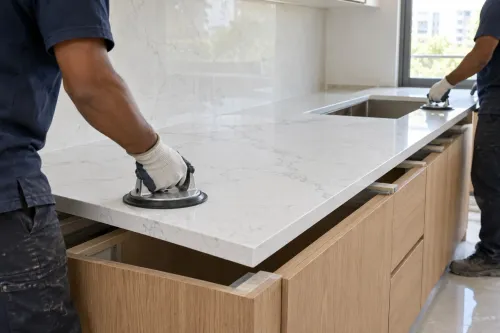
Porcelain is a strong choice for a Bangalore kitchen when the cabinets are rigid, level and continuously supported, and the slab can reach the site without being twisted or struck. A large island can look almost joint-free, but measure lift doors, stair turns and balcony access before choosing a full-size slab.
Unsupported overhangs are a warning sign. Keep cantilevers within the fabricator’s design limits and add concealed brackets or legs where people will sit, lean or place heavy appliances. Slab thickness alone does not make an overhang safe; cabinet movement and point loads cause cracks.
Plan every opening before fabrication. Sink cut-outs and hob cut-outs weaken the panel, so generous corner radii, accurate templates and reinforced support around each opening matter. An undermount sink creates a vulnerable exposed edge; a top-mount sink hides more of that edge and suits a higher-impact kitchen.
Porcelain handles direct sun well, making it useful beside bright windows or in a sunlit kitchen. It still needs a trivet: a hot pan can shock the slab, damage an edge or mark an unsuitable finish.
Choose another surface, or redesign the layout, when:
- The island needs a deep unsupported cantilever.
- Cabinets flex, settle or lack continuous support.
- The route includes tight lifts, narrow stairs or difficult balcony handling.
- The design has many close cut-outs, sharp internal corners or fragile edge details.
- You want to drag heavy cookware across the surface without accepting porcelain slab limitations.
Confirm fabrication and installation warranty before ordering a porcelain kitchen worktop.
How porcelain slabs extend beyond the worktop
Porcelain works beyond the worktop wherever you want a continuous, low-absorption surface with fewer joints: backsplashes, island cladding, bathroom furniture and shower walls.
| Application | Finish and pattern choice | Maintenance and installation point |
|---|---|---|
| Porcelain backsplash | Glossy finishes wipe clean easily; continue the worktop pattern upward for a quieter, more spacious look. | Seal the wall junction, socket cut-outs and counter joint. Grease, cement residue and metal marks still need prompt removal. |
| Waterfall island | Match the vein direction across the top and down the sides, or choose a restrained concrete pattern that hides alignment changes. | Large mitred edges demand accurate fabrication and solid cabinet support; a dramatic pattern makes a mismatched seam obvious. |
| Bathroom vanity | Satin or matte surfaces reduce reflections and show fewer water spots; bookmatched or lightly veined slabs add visual depth. | Seal the basin cut-out, wall joint and tap penetrations. Low absorption does not protect the cabinet or substrate from leaks. |
| Shower wall panels | Matte or textured finishes improve visual grip and conceal droplets; continuous veining can make a small bathroom feel larger. | Waterproof the underlying wall first, then seal panel joints, corners and plumbing penetrations. Hard-water deposits still require manufacturer-approved cleaning. |
Use the same slab across a backsplash, vanity and shower wall when pattern continuity matters, but confirm slab dimensions before committing. Large panels reduce grout lines while increasing lifting, access and breakage risk during installation.
What a safe porcelain-slab installation involves in Bangalore
A cracked sink corner often begins before cutting: with a wrong measurement, weak cabinet support or an unsuitable slab layout. A safe porcelain slab installation in Bangalore starts with a site survey that records walls, cabinet levels, island dimensions, lift or staircase access, overhangs, hob and sink positions, sunlight and hot-pan use.
Select the slab only after checking that its dimensions, finish, pattern direction and cut-out locations suit the room. Confirm the fabricator’s experience with that slab system, plus separate warranties for fabrication and installation. Countertops Gallery, for example, can help compare a visually continuous layout against the access and support limits of your kitchen.
The installation sequence should include:
- Measure and photograph access routes; plan slab transport with sufficient people, A-frame protection and no twisting during lifting.
- Install rigid, level cabinets and a continuously supported substrate before templating. Do not rely on thickness alone to prevent cracks.
- Make a digital or rigid template, then position seams away from sink and hob corners where possible.
- Cut with diamond tooling and controlled feed rates. Wet cutting porcelain, local exhaust, housekeeping and suitable respiratory protection control silica dust; never dry-cut with an angle grinder inside an occupied home.
- Dry-fit every piece, inspect edges and cut-outs, then adjust before adhesive is applied.
- Reinforce sink cut-outs and unsupported overhangs according to the fabricator’s system; point loads and cabinet movement can crack the slab.
- Finish edges with progressive diamond abrasives, install the sink with the specified supports and sealants, then remove adhesive, cement residue and metal marks using the manufacturer’s cleaning guidance.
Related services
Porcelain slabs . View service → |
Porcelain slabs . View service → |
Frequently asked questions
What are porcelain slabs made from?
They are made from refined mineral powders pressed into large sheets and kiln-fired into dense porcelain. Their composition provides very low water absorption without the polymer binder used in quartz.
How does porcelain compare with quartz, granite and marble?
Porcelain offers low water absorption and broad design continuity. Quartz provides consistent engineered patterns, granite offers natural stone variation, and marble delivers distinctive veining but requires more care against staining and etching.
When is porcelain the right choice for a Bangalore kitchen?
Porcelain suits kitchens where you want low water absorption, a large-format look and applications beyond the worktop. Review edge details, impact exposure, cut-outs and local installation capability before choosing it.
Where can porcelain slabs be used besides worktops?
They can extend across splashbacks, wall cladding, kitchen islands, bathroom walls and other interior surfaces when the substrate and fixing method are suitable.
What does a safe porcelain-slab installation involve in Bangalore?
A safe installation requires accurate site measurements, suitable support, trained slab handling, correctly planned cut-outs, reinforced vulnerable areas and careful fixing of the finished panels.
Related services
Porcelain slabs . View service → |
Porcelain slabs . View service → |
Porcelain slabs . View service → |
Porcelain slabs . View service → |